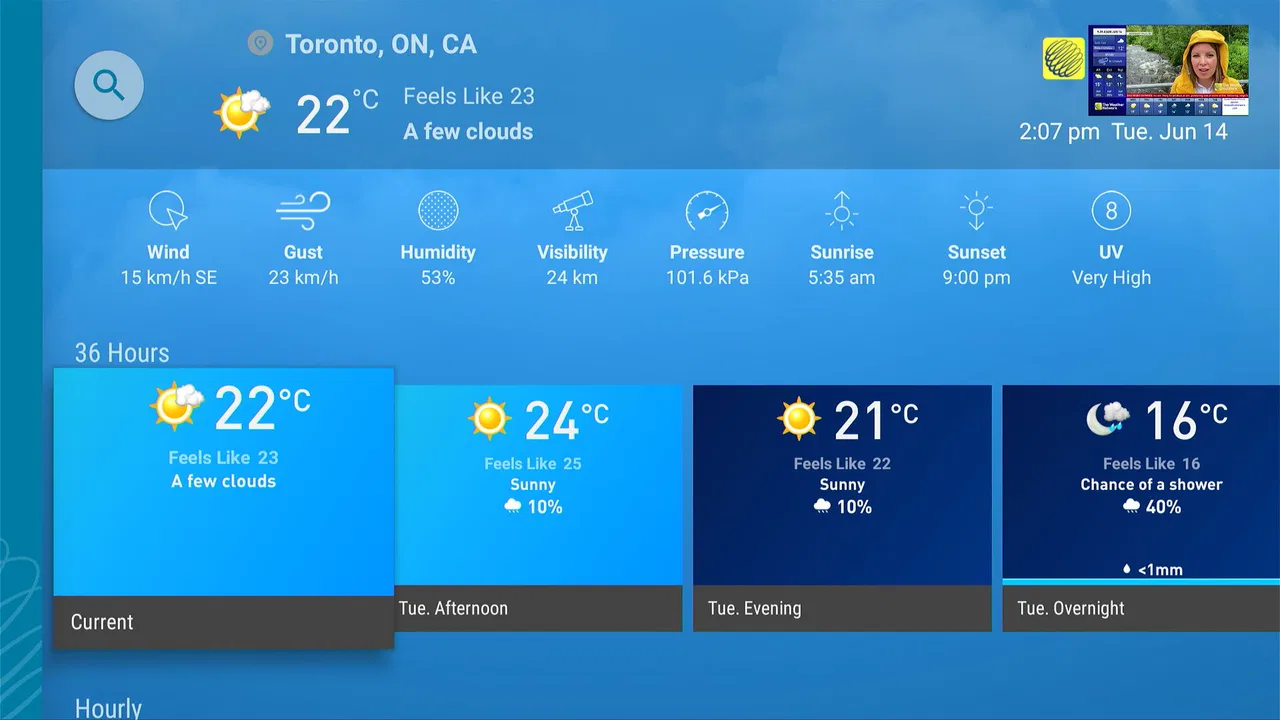
The Weather Network TV App
- 3.0
- Rating
- 1.00M
- Installs
- Free
- Price

 Analysis by App-foxy
When I want a quick sense of whether I should leave home with a coat, delay a walk, or rethink a drive, I prefer a weather app that gets to the point. The Weather Network TV App is built for that everyday need, with a familiar focus on current conditions and forecasts rather than a crowded collection of unrelated tools. I spent time using it as a practical weather reference, and my overall impression is mixed: it is approachable and useful for routine checks, but its average rating of 3.0 shows that it has not satisfied everyone.
This is a free weather app from The Weather Network & MétéoMédia, available to an Everyone audience. It has passed the one-million-install mark, so it is clearly used by a substantial number of people. The app first appeared on August 12, 2015, and the current version is 4.4.5. It runs on Android devices using version 5.0 or later, which makes it accessible to many older phones as well as newer models.
What I looked for beyond the forecast
Weather apps are easy to compare at first glance. Most show a temperature, a symbol, and some kind of hourly or daily outlook. The more important differences appear when I use one repeatedly: how quickly I can reach the information I need, how much surrounding content competes for attention, whether location choices feel clear, and whether I remain comfortable with the app’s controls.
You May Also Like

 Blood Strike: 2.5 Anniversary
Blood Strike’s Loadouts Turn Every Drop Into a Tactical Gamble
A close look at Blood Strike’s custom loadouts: how fast access to signature weapons reshapes its battle royale rhythm, rewards preparation, and narrows the gap between fights.

 Pandora - Music & Podcasts
Pandora’s Music Is Easy to Start, but Harder to Recover
Pandora’s strength is its low-effort path from a seed to a station. Its weak spot is how much confidence it asks you to place in connection, setup, and quiet recovery.

 8 Ball Pool
 Is Built on Rivalries, Rematches, and Routine
A close look at the rivalries, rematches, shared routines, and unanswered safety questions that turn a quick pool match into a persistent mobile community.

 Samsung Music
’s Quiet Strength Is Playing What You Already Own
Its reach comes less from spectacle than from dependable access to a personal library. That simplicity is both the app’s strongest retention engine and its ceiling.

 AccuWeather: Weather Radar
AccuWeather Review: A Quick, Clear Forecast for Everyday Decisions
For everyday plans, the best forecast is the one you can understand quickly. AccuWeather makes rain timing, radar, and local conditions easy to act on, with a few trade-offs.

 Hill Climb Racing
Why Hill Climb Racing Still Turns Crashes Into One More Run
A tiny car, a bumpy hill and one more upgrade: Hill Climb Racing keeps resurfacing because its simple chaos makes every near-miss feel personal.
More From Our News Desk



That last point matters more than it may seem. A weather app often knows where I am, or at least asks to use location information, because local conditions are its main purpose. I do not treat that as an automatic reason to reject it, but I do pay attention to whether I can choose a location manually, whether the app explains what I am allowing, and whether I can avoid sharing more than is necessary for my use. These are practical trust questions, not abstract technical concerns.
With The Weather Network TV App, I would begin by checking the permission prompts and the available settings on my own device rather than accepting every request without reading. Android’s permission controls are the best place to review what the app can access. If I only need forecasts for a saved city, I would first see whether manual location selection is enough for my routine. That approach gives me more control than leaving location access open simply because automatic convenience sounds attractive.
The app’s name suggests a connection to a television-oriented weather service, but I would not install it expecting a full replacement for a broadcast channel or a dedicated emergency-alert system. I see it primarily as a mobile weather reference. That distinction affects how I use it: I check it before making ordinary plans, while I look to official local authorities for urgent warnings or instructions.
A sensible first setup
My preferred setup for any weather app is deliberately conservative. I choose the location I care about most, inspect notification options, and turn off anything that does not help me make a decision. If I am testing the app in a new place, I compare its location result with the city or neighborhood I actually mean to monitor. A forecast for a nearby large city can be less useful than one for the exact area where I will spend the day.
This is also where I decide whether automatic location is worth the trade-off. It is convenient when I travel, especially if I move between towns, but it can involve more frequent location checks than a fixed saved location. For a person who checks the weather only at home, a manually selected location may be the calmer and more privacy-conscious workflow. For someone who commutes or travels, automatic updates may save time, provided the permission settings are understood.
I would also review notifications before relying on them. A notification can be helpful when I am rushing out the door, but repeated or poorly timed alerts quickly become noise. The useful habit is to keep only the notices that influence a real decision, such as a major change that affects a planned trip, and remove the rest. The exact controls available can depend on the installed version and the phone’s Android settings, so I would verify them directly rather than assuming every option is present.
How it fits into an ordinary day
Imagine I am leaving early for work and have an outdoor appointment after lunch. I open the app in the morning, check the current conditions, and then look at the expected change through the day. I am not trying to study meteorology; I want to know whether light clothing makes sense, whether rain could affect the appointment, and whether I should carry an umbrella.
Later, I would check again before leaving rather than trusting a single morning glance. Weather changes, and a forecast is a planning aid rather than a promise. The app is most useful in this short-check routine: open it, confirm the relevant location, inspect the next few hours, and make a practical choice. It becomes less useful when I expect it to remove all uncertainty or provide a perfectly precise answer for a specific street.
A less obvious tip is to separate “what is happening now” from “what I need later.” Current conditions can make the day feel settled, but they do not necessarily answer whether a later outdoor plan is sensible. I would make a habit of checking the forecast window that matches my activity instead of relying only on the main current-weather screen. That small change prevents the common mistake of seeing a pleasant morning and assuming the whole day will remain the same.
Trust, permissions, and visible choices
I judge this app’s trustworthiness through choices I can actually inspect, not through assumptions about what happens behind the scenes. The important checks are straightforward: which permissions Android displays, whether I can deny location access, whether I can select a place manually, how notifications can be managed, and whether I can control or remove saved locations. Those controls should be reviewed on the device, because Android’s permission interface and the app’s own settings work together.
I would be particularly careful during the first launch. Permission requests can feel harmless when they appear beside a weather forecast, but I prefer to read each one and decide based on how I intend to use the app. If the app works for my needs with a selected city, I would not grant location access merely out of habit. If I need travel convenience, I would grant only the level of access that matches that need and revisit it later.
There is another data-sensitive moment when notifications are enabled. Notifications can expose information on a lock screen, including the fact that I am monitoring a particular place or receiving a weather-related message. That may be insignificant for many people, but it is still worth checking the phone’s notification privacy settings. I would choose whether the full message, a shortened preview, or no lock-screen content feels appropriate.
I also avoid treating the app’s install count or developer identity as proof that every privacy concern is solved. The developer is The Weather Network & MétéoMédia, and the app has a large user base, but popularity does not replace reading the permission prompts and available controls. My confidence comes from being able to see and manage the choices that affect my own use.
Where the app helps, and where I would be cautious
The strongest use case is quick, repeated checking for a known location. I can imagine recommending it to someone who wants a straightforward weather companion for commuting, school runs, errands, or weekend plans. The free price removes a financial barrier, and the Everyone rating makes it suitable for a broad household audience. Its long availability also means it is not a brand-new experiment that has appeared without any history.
Still, the rating of 3.0 is an important warning sign. I would not dismiss the app because of that number, but I would take it as a reason to test it personally before making it my only weather source. Ratings can reflect different expectations: some people want a simple forecast, others expect flawless alerts, highly detailed maps, minimal advertising, or a very polished interface. A person who needs specialized weather information may be disappointed even if the basic forecast experience is adequate.
My main caution is that a general weather app should not be the sole authority during dangerous conditions. For severe storms, flooding, wildfire smoke, hurricanes, or other emergencies, I would check official government and local emergency sources as well. The app can help me notice that conditions are changing, but safety decisions should use the most authoritative warning channel available in my area.
I would also skip it if my priority is complete privacy with no location-related interaction at all and I do not want to manage permissions manually. A manually selected city may reduce the need for automatic location, but anyone unwilling to inspect settings may prefer a simpler source that requires less personal-data decision-making. Conversely, someone who travels constantly may find manual location changes inconvenient and should test whether the app’s location workflow is smooth enough before depending on it.
Comparing it with familiar alternatives
Compared with the default weather widget on a phone, this app is appealing when I want to open a dedicated weather service rather than rely on a compact glanceable display. A built-in widget may be faster for the current temperature, while a dedicated app can offer a more focused place to inspect forecasts. The trade-off is that another installed app means another set of permissions, notifications, and settings to manage.
Compared with a browser search, the app can be more convenient for repeated checks because I do not need to search for the same city each time. A browser is useful when I want to compare several sources or avoid installing an app, but it can be slower and less consistent as a daily routine. I would choose the app for habitual monitoring and the browser when I want a second opinion.
Compared with a local government weather service, this app is likely to feel more convenient for everyday planning, while the official source remains more important for warnings and public safety instructions. I would not frame that as a competition where one completely replaces the other. The practical combination is to use a general forecast app for normal decisions and official channels for high-risk conditions.
Compared with a highly specialized weather tool, the attraction here is approachability rather than technical depth. If I am planning aviation, marine travel, agriculture, photography, or a weather-sensitive outdoor event, I would look for an app designed around that specific activity. For deciding whether to bring a jacket or move a casual outing indoors, a general service is usually enough.
Small habits that make the experience better
One useful habit is to keep the number of monitored places limited. Saving every city I might visit can turn a quick check into unnecessary scrolling and make it easier to read the wrong forecast. I would keep my home, workplace, and one temporary destination, then remove the temporary place when the trip is over.
Another is to check the app at decision points rather than constantly. I would look before leaving home, before an outdoor activity, and before a return journey if the weather is unstable. Constant refreshing does not guarantee better decisions and can encourage false confidence in small forecast changes.
I would also compare the forecast with what I can observe. If the app suggests one thing but the sky, wind, or local conditions clearly point elsewhere, I would treat that mismatch as a reason to recheck the location and consult another source. This is especially important in places where conditions vary sharply over short distances.
Finally, I would revisit permissions after using the app for a while. A permission granted during setup can remain enabled long after my needs change. If I stop traveling, I may no longer need automatic location. If notifications become distracting, I can reduce them through the app or Android settings. The best experience is not the one with every option enabled; it is the one that gives me useful weather information with only the access and interruptions I actually want.
My cautious recommendation
I see The Weather Network TV App as a reasonable free option for ordinary weather checks, especially for people who want a dedicated service from The Weather Network & MétéoMédia and are comfortable reviewing location and notification controls. It is suitable for everyday planning, works on older Android devices beginning with version 5.0, and is available to an Everyone audience. The current version, 4.4.5, is the one I would test rather than relying on impressions from older releases.
My recommendation is conditional because the 3.0 average rating deserves attention. I would install it, select a familiar location, inspect every permission prompt, and use it alongside an official warning source before deciding whether it deserves a permanent place on my phone. If the basic forecast workflow feels clear and the controls match my privacy preferences, it can become a convenient daily tool.
I would choose something else if I needed highly specialized weather analysis, strict notification discipline without any setup, or a single authoritative source for emergencies. For everyone else, the app is worth trying as a practical forecast companion, provided expectations remain realistic. It can help me plan the day, but it cannot make uncertain weather certain, and trust should come from active user choices rather than passive acceptance of the default setup.
FAQs for The Weather Network TV App
01What features does The Weather Network TV App offer?
The Weather Network TV App provides users with real-time weather updates, detailed forecasts, and severe weather alerts. It includes interactive radar maps, personalized weather information based on your location, and customizable notifications. The app also offers video forecasts and weather news to keep users informed about the latest weather conditions.
02Is The Weather Network TV App available for free?
Yes, The Weather Network TV App is free to download on both Android and iOS platforms. The app offers a variety of features at no cost, though there may be optional in-app purchases or subscriptions available for users who wish to access additional features or an ad-free experience.
03How accurate is the weather information provided by the app?
The Weather Network TV App is known for its high accuracy in providing weather forecasts. It uses data from multiple sources, including satellite imagery, radars, and local weather stations, to deliver precise weather updates. However, as with all weather services, unexpected changes in weather conditions can occur.
04Can I use The Weather Network TV App offline?
While you can view previously loaded data offline, The Weather Network TV App requires an internet connection to update forecasts and provide current weather information. It is recommended to have a stable internet connection to ensure you receive the latest updates and alerts.
05Does The Weather Network TV App send severe weather alerts?
Yes, the app sends timely severe weather alerts to keep users informed about potentially dangerous conditions. You can customize the types of alerts you receive and set them for specific locations. This feature ensures you are prepared for unexpected weather events and can take necessary precautions.
Pros
- Accurate
- real-time weather updates.
- User-friendly and intuitive interface.
- Customizable weather alerts.
- Detailed radar and satellite imagery.
- Supports multiple locations tracking.
Cons
- Occasional ad interruptions.
- Limited offline functionality.
- Some features require premium.
- Battery consumption can be high.
- Requires stable internet connection.

The Weather Network TV App
Gallery